New Fiat Panda will remain a petrol-powered people’s car
Fiat's legendary Fiat city car looks ready to make comeback before the end of the decade

Key details about a future replacement for the current Fiat Panda – dubbed Pandina in its home market of Italy – have been revealed as Fiat looks to consolidate its ‘legacy’ model names and bolster its line-up of small cars.
The Panda is no longer available in the UK, having been axed here in 2024. But while we have the newer Fiat Grande Panda, the old ‘Pandina’ supermini is still the most popular car in Italy following an update to comply with impending Euro 7 emissions standards.
That gives the car a stay of execution in Italy until at least 2029. However, around that time we can expect an all-new replacement, likely to be called Panda in the UK, that will follow Fiat’s current multi-fuel strategy and be offered both with a small, mild-hybrid petrol engine, as well as – for the first time – a full-EV powertrain.
Speaking to Auto Express at a recent micromobility event in Rome, Gaetano Thorel, head of Fiat and Abarth Europe, said the company has a responsibility to the 100,000 people who buy a Pandina each year. “At Fiat I think we have a duty. I always talk about ‘Il Popolo de Pandina’, the Pandina population, that we need to give them a future. So, in a way or another, Pandina will stay.”
Asked what powertrains the Pandina (Panda) should have in the future, Thorel replied: “I think we need to have a multi-energy solution. We need to get the customers at the centre.” Having previously spoken about less-than-expected zero-emission sales mix in Europe, Thorel added: “We cannot simply take decisions based on regulation.”

Future Fiat Panda: design
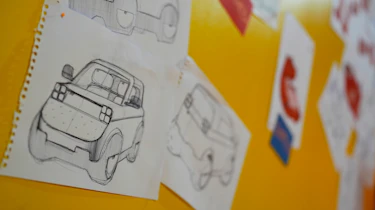
The next Panda is already undergoing a design process that Fiat CEO Olivier Francois has called “democratic”. The basic concept of the new car has been previewed by a trio of student design studies, each said to demonstrate Fiat’s “vision for the future of urban mobility as a socially relevant, culturally driven and design-led experience”. Meanwhile, a public vote at this year’s Milan Design Week has already influenced Fiat’s eventual production version.
The Pandina will be simple and cost-effective to its core. Francois commented: “A car should be useful before it is sophisticated. Customers aren’t asking for bigger displays, they are asking for more things that just make sense. If you want that, Fiat is answering those questions.”
Fiat Ippo: a future city car with ‘rhythm’ and most popular design
The first visual concept is titled ‘Ippo’: a small, upright four-seater, with two doors, a raised ride height and tall roofline. At the Milan Design Week the Ippo was voted as the most popular, though Thorel told Auto Express that the final car could take inspiration from all three designs. “Certainly, they are all a source of inspiration,” he said. “Then of course, we need to be true to our DNA.”
There are plenty of similarities with the existing Pandina – a car that continues to make up 7.5 per cent of the Italian new-car market – including the extensive cladding along the sills, bumpers and wheelarches.
Ippo is apparently “not just a means of transport” but something that “fosters interactions and adapts to the rhythms of small towns”. The project proposes “a more human, shared vision of mobility, where the car becomes an extension of public space, strengthening the sense of community.”
Fiat Lumo su Misura: the versatile Italian MINI?
Another design put forward for the next Panda was ‘Lumo su Misura’, which in its basic form looks similar to a narrower, more upright modern MINI, with a squared-off shape and round headlights. However, the concept is based on the themes of flexibility and personalisation; the vehicle can “evolve with its user, addressing the common compromise young drivers face between affordability and self expression”.
The car can, in theory, transform from city car to camper van, off-road vehicle to practical MPV. The students said that “instead of being a single, fixed product, it offers a range of possibilities within one platform”. Parts can be purchased or rented, either new or refurbished.

Fiat Fizz: a mobile meeting place
The final proposition is perhaps the most radical, and the furthest from a traditional city car or supermini. Titled ‘Fizz’, it plays on the vehicle’s use when stationary, rather than on the move. The student responsible started with the question: “How can a small city car create a temporary social space when it stops?”
“The role of the car is changing,” they said. “It is no longer about just moving through the city, but also about how we experience the time between one destination and another. Innovation is not about moving faster, but about stopping better.”
Fizz therefore looks more like one of those pedal-powered beer bikes you might find cruising around holiday destinations filled with tipsy tourists on a boozy night out. Its wheels are pushed out into the corners, while above the beltline sits an upright glasshouse and tall, flat roof. The interior comprises front and rear bench seats; entry and exit should be easy due to the lack of a B-pillar, and the doors open at either end.
Next Fiat Pandina: how to make it work
Each car is simply a concept for now, but Thorel insisted the project “will give us a lot of help” for the next-generation Pandina.
He exercised some caution over keeping the current Panda’s look however, “When I look at Pandina design, it's very unique. There are some elements that you need to keep because it makes the car. The curved C-pillar is very Pandina and if you just change it, you lose the connection with the Pandina population. Also, the front, it's pretty, Pandina.”
The Panda’s looks might change quite drastically, but its use-case will stay the same according to Thorel. “[Customers] need the Pandina to be small enough to move in the city, big enough to bring the family on vacation – from Milan maybe to Naples,” he told us. “What is the right energy for this customer? It cannot be electric. If I need to go from Milan to Naples, however efficient my battery is, how many times will I need to stop?
“But for the other customer, this car can be electric. If my second house is one hour from my city, I can drive electric, no problem. That’s why it’s so important to be multi-energy,” the Fiat boss said.
Asked if this shift to electric could open the Pandina back up to markets outside of southern Europe, Thorel said: “Technically, yes. The question is: what is the volume potential? The A-segment in Europe is pretty limited. So yes, it would open for sure, but I don’t know, honestly, how much.”
He again emphasised how important his Italian customers would be in shaping the next Pandina: “Whatever the next compact car, I have one duty,” he said. “That is to give the right solution to the ‘Popolo di Pandina’ – the Pandina customer base. Because in reality, in Italy, it’s a real population. We’re talking millions; on average, every year we sell 100,000 Pandinas. If I don’t give them the next generation that fulfils what they need, one that moves them into the future, I don’t think we will honour our role.

“That’s why the three design projects are an interesting discussion. The projects are made by 22, 23-year-old designers. So they are the future. They interpret the next generation.”
Regardless of form, it’s likely any future Pandina would move from its ancient Fiat underpinnings to sit on one of parent company Stellantis’s cutting-edge platforms. However, in a previous conversation with Auto Express, Francois said the Smart Car platform, which underpins the larger Fiat Grande Panda, Citroen C3 and Vauxhall Frontera “can’t go any smaller than four metres”. The future Pandina isn’t expected to exceed 3.6 metres long.
The newly unveiled STLA One platform doesn’t seem likely either, because it’ll probably be too expensive to turn a profit on a car expected to cost under £15,000. It can also only shrink to B-segment cars, while the Panda looks set to cross into A-segment territory to rival the Dacia Spring and Leapmotor T03.
There is a chance Fiat may choose to place the Pandina on the same platform as the 500, which was recently adapted to support both EV and hybrid technology. If this does transpire, we can expect to see the same 1.2-litre non-turbo three-cylinder petrol engine mated to a mild-hybrid motor producing around 70bhp. Either way, the new Pandina isn’t going to be setting any land-speed records.
With economies of scale, that should help keep costs down, allowing the new Pandina to continue to serve customers at the lower end of Europe’s new-car market – even if the “psychological threshold” of 10,000 Euros will be harder than ever to achieve as we move into 2029 and beyond.
In order to make the sums work, the Pandina will be designed to be simple and cost-effective at its very core. Francois told us: “It will have the same philosophy as the Centoventi [concept from 2019]. It needs to be simple, innovative. What can we leave out? What do we actually need inside? This will help keep the costs down.”
Did you know you can sell your car through Auto Express? We’ll help you get a great price and find a great deal on a new car, too.